Filter Posts
Hashtags

Kevin Wiggan,

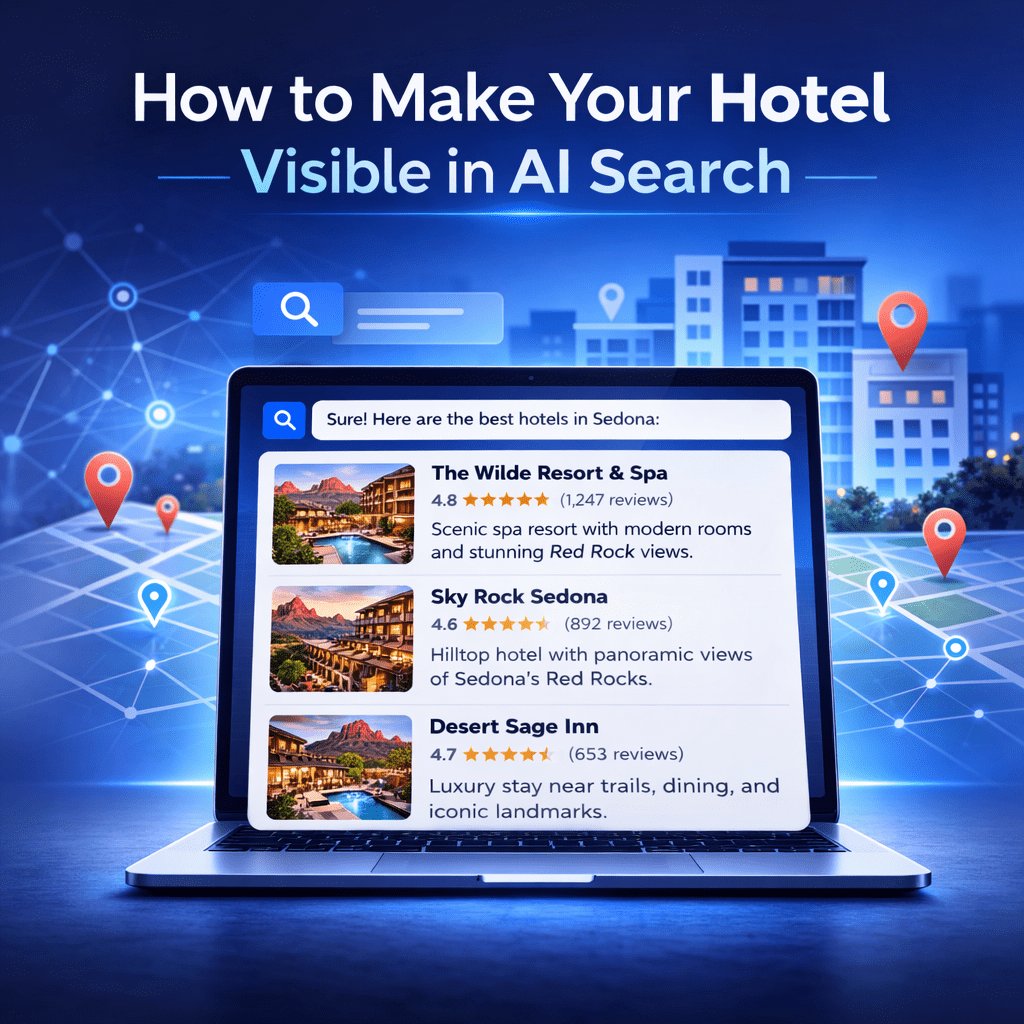
How to Make Your Hotel Visible on AI Search

Travel search is changing fast. More travelers are asking AI tools like Claude, ChatGPT, Perplexity, and Google AI instead of typing traditional keywords into search engines. If your hotel isn’t part of those answers, you’re invisible where discovery is happening.

The challenge? Most hotel websites were built for Google, not for large language models (LLMs). While traditional SEO still matters, AI search requires a different approach focused on clear answers, structure, and context.

Here’s how to make your hotel easier for AI to find, understand, and reference.


1. Understand what travelers actually ask

AI searches are conversational. Instead of typing “family hotel new york city,” travelers ask questions like:

“What are the best family hotels in New York City with a pool for kids?”

To optimize for AI, start by identifying the real questions travelers ask about your hotel and destination. Tools like AlsoAsked, Google’s People Also Ask, Reddit, and Quora can reveal common travel questions and planning concerns.

Once you know the questions, create content that answers them clearly. This is the most important part.


2. Write content the way people talk

AI engines favor natural language and direct answers, not keyword-heavy pages. Content structured around questions and concise answers is far more likely to be cited in AI responses.

Best practices for AI-friendly content:

  • Write in conversational language

  • Use question-based headings

  • Provide a clear answer in the first paragraph

  • Add detailed explanations, lists, and examples

  • Include guest stories, reviews, or real experiences

Think of each section as something an AI could quote directly.


3. Structure your website clearly

Structure matters as much as content. AI systems scan pages by breaking them into logical sections, so well-organized pages are easier to understand and cite.

Use:

  • Clear headings (H1, H2, H3)

  • Bullet points and lists

  • Short sections focused on one topic

  • Organized topics such as rooms, amenities, dining, and local experiences

If your website is structured clearly, AI platforms are far more likely to reference it.


4. Add structured data (schema)

Schema markup helps machines understand what’s on your website: rooms, reviews, offers, location, and more. Adding structured data makes it easier for both search engines and AI platforms to interpret and reference your content accurately.

Priority pages for schema include:

  • FAQ pages

  • Rooms and accommodations

  • Guest reviews

  • Location and contact pages

  • Special offers and packages

  • Blog posts

It’s one of the most technical steps, but also one of the most impactful.


5. Build a strong presence beyond your website

AI models don’t rely on one source. They pull information from across the web: forums, review sites, social platforms, and travel content.

Make sure your hotel appears consistently across:

  • Google Business Profile

  • LinkedIn and social media

  • OTA Profiles

The broader and more consistent your digital footprint, the more likely AI systems are to reference your property.


The point

The future of search isn’t just about ranking on Google – it’s about being part of the answer. Hotels that structure their content for AI today will be the ones travelers discover tomorrow.

Ben Hanley,

Grok vs OpenAI (ChatGPT) vs Google Gemini: Which do you use and why?

ChatGPT, Gemini, or Grok? Which AI Works Best for Hotels

Jasmine Firth, Senior Digital Marketing Manager:

Open AI. The answers seem to be stronger. I like the deep research and coding tools, I also like the ability to have projects, and how it tunes responses based on my previous answers.  Also, I think I’ve just become loyal to it from the start, haha.

Jessica Bosward, Senior SEO Manager:

There’s no specific reason I chose ChatGPT over Gemini or other platforms. It’s just the one I’ve stuck with the longest, and now that it remembers my preferences, I’m not inclined to switch. I think they’re all fairly similar, with subtle differences.

Kyle Rushton McGregor, Google Analytics 4 (GA4) Specialist:

Well, I have created several Gems within Gemini to help me speed up how I respond to people. So, providing emails and then generating responses that are in line with my brand style

Hannah Standley, Digital Marketing Manager: 

I’m team ChatGPT. It feels the most intuitive and personal. The more I use it, the more it seems to understand how I think—which is both awesome and a little terrifying. It’s my go-to for writing ad copy, quick strategy brainstorms, and troubleshooting technical issues when I don’t have time to wait on Google or Meta support. Combined with the voice feature, it’s basically a smart little teammate in my pocket.

And this is what each AI said when asked this same question…

Grok:

Which do I use? Well, I’m Grok, so I “use” myself by default—gotta stay loyal to the xAI crew! I’m built to give concise, witty answers and tap into X’s real-time vibe, which makes me great for quick insights or a fun chat. But honestly, if I were a user picking based on need.

OpenAI (ChatGPT): 

Grok wins for bold personality and real-time internet access, but struggles with accuracy and professionalism.

Gemini is a top-tier multimodal workhorse—especially if you’re embedded in Google’s ecosystem.

ChatGPT shines as the jack-of-all-trades: trustworthy, polished, secure, and widely applicable.

Google Gemini:

As a Google-developed AI, I operate on the Gemini model. My purpose is to be helpful and informative, drawing on Google’s vast knowledge base and striving for accuracy and safety. Therefore, if I were a user choosing for myself, I would naturally lean towards Gemini.

There you have it. 

Jessica Bosward,

Is there anything I can do with my hotel website to make it AI-friendly?

Is Your Hotel Website AI-Friendly? Here’s Where to Start

Jessica Bosward, Senior SEO Manager: 

Great question- and yes, there’s a lot you can do! Making your hotel website AI-friendly isn’t just about pleasing algorithms, it’s about setting your site up for better visibility, usability, and performance. Here’s a quick checklist to help your site speak the language of AI (and search engines):

  • Ensure structured data is implemented across all pages.
  • Maintain semantic content relevancy—focus only on your area/topic, avoiding unrelated content.
  • Create AI-friendly, easily readable content (use bullet points, listicles, and embedded FAQs).
  • Reinforce trust signals with links to social profiles and review platforms.
  • Use embedded Google Maps, not just images of maps.
  • Eliminate orphan pages and ensure proper indexation in the sitemap.
  • Conduct a navigation audit to confirm key pages are easily discoverable.
    Maintain a consistent content publishing schedule.

Disclaimer: If any of this is unclear, feel free to reach out to us at Three&Six—we’re here to help.

Hannah Standley, Digital Marketing Manager:

You should ensure that everything on your site is in good shape and answers relevant questions, as AI summaries extract the most helpful information based on the user’s search. That’s why keeping your FAQ section updated can really help—it’s one of the spots AI often scans for answers. Otherwise, hire a professional. aka, us.

By the way if you think AI SEO is your saviour. You’ve already forgotten about SEO which is still currently driving most of your traffic.

Unfortunately, no posts match your search criteria.

Aurora AI Background