How AI Search Is Changing the Way Travelers Discover Hotels | Part 1
The hotel discovery journey is getting a little more complicated
Think about how someone might plan a weekend getaway to Sedona.
Not too long ago, that process probably started with a Google search. They’d browse a few hotel websites, check TripAdvisor, compare prices, look at photos, and eventually narrow things down to two or three properties.
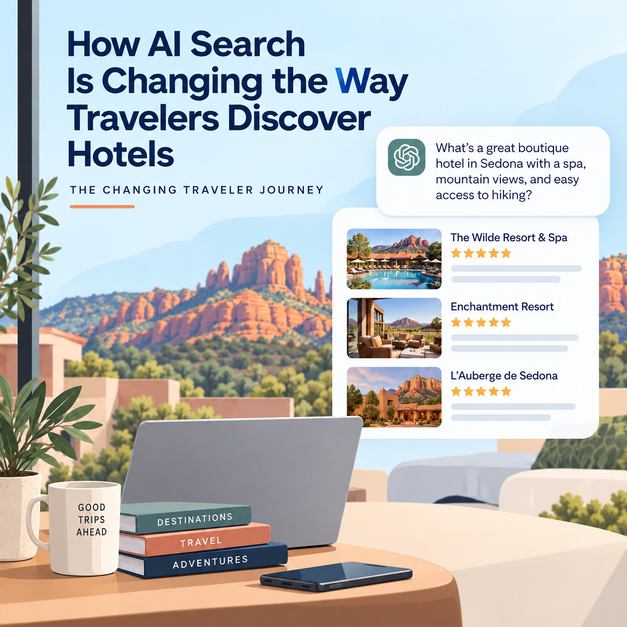
Today, that same traveler might start by opening ChatGPT and asking:
“What’s a great boutique hotel in Sedona with a spa, mountain views, and easy access to hiking?”
Instead of sorting through pages of search results, they get a handful of recommendations based on what they’re looking for.
They might follow up by asking which hotel has the best location for hiking, whether any offer couples’ packages, or which properties have restaurants on-site.
By the time they actually visit a hotel website, they may already have a pretty good idea of where they want to stay.
That’s a meaningful shift for hotel marketers.
We’re used to thinking about visibility in terms of Google rankings, paid search, metasearch, and OTA placement. Now there’s another place where travelers are discovering and evaluating properties, often before they reach any of those traditional channels.
And it raises a question worth paying attention to: When someone asks AI for a hotel recommendation in your destination, does your property come up?
Travelers are interested in AI, but they’re not ready to trust it completely
There’s no shortage of interest in using AI for travel planning. The more interesting question is how comfortable travelers actually feel relying on it.
Booking.com’s 2025 Global AI Sentiment Report surveyed 37,325 consumers across 33 markets. The research found that 89% wanted to use AI in future travel planning, but only 6% said they fully trusted it.
That’s quite a gap.
Travelers are willing to experiment with AI to discover destinations, compare hotels, and put together itineraries. But when it comes time to spend money on a trip, trust still matters.
Expedia Group’s April 2026 research reinforces that point. Among adults surveyed in the US, UK, and India, 68% said they’d rather book with a trusted travel brand than through an AI chatbot or agent, even when AI booking was available.
For hotels, the distinction is important.
Someone might discover your property through ChatGPT, look it up on Google, read a few reviews, and then book directly through your website.
AI helped put your hotel on their radar, but it wasn’t necessarily where the reservation happened.
That means we shouldn’t think of AI discovery and AI booking as the same thing. They’re different parts of the travel planning process, and each presents its own opportunities and challenges.
So, what does this actually mean for hotel marketing?
For years, hotel SEO has focused on making sure properties appear when travelers search for relevant destinations, accommodations, and experiences.
That work isn’t going away.
But AI adds another layer to the process, and it’s one that isn’t always easy to measure.
Let’s say someone asks ChatGPT for a luxury resort in Sedona with a spa and access to hiking trails. Your property appears in the recommendations, and the traveler decides to learn more.
They close ChatGPT, search for your hotel by name on Google, and eventually make a reservation.
Your reporting might show a branded search followed by a direct booking. What it probably won’t show is that the traveler first discovered your property through an AI recommendation.
This is one of the challenges hospitality marketers will need to work through as AI becomes a more established part of travel research.
We’re accustomed to measuring performance through website sessions, clicks, conversions, and revenue. AI can influence a traveler’s decision before any of those measurable interactions happen.
It doesn’t mean our existing reporting is suddenly irrelevant. It means there may be more happening before a traveler arrives on our website than our analytics can currently tell us.
Start by looking at how AI represents your property
You don’t need to overhaul your entire marketing strategy to start understanding your hotel’s AI visibility.
A useful starting point is to look at the types of questions your ideal guests might ask when planning a trip.
For a boutique property in Sedona, that might mean asking AI about romantic getaways, spa resorts, hotels near popular hiking trails, or accommodations with red rock views.
Then look at the answers.
- Is your hotel included in recommendations that are relevant to your property?
- Does AI describe your location, amenities, and overall experience accurately?
- Are your property’s unique selling points coming through, or does the description sound like every other hotel in the destination?
- Which websites and sources appear to be informing the recommendations?
That last question is particularly interesting.
Your hotel’s own website is important, but it isn’t the only place AI may find information about your property. Third-party websites, travel publications, OTA listings, and other publicly available content can all contribute to how a hotel is represented.
If those sources contain outdated or inconsistent information, travelers could encounter an inaccurate description of your property before they ever visit your website.
And unlike a traditional Google search, where someone can quickly scan multiple results, an AI-generated answer may present that information as a single, cohesive recommendation.
That’s why it’s worth paying attention not just to whether your hotel appears, but also to what AI is actually saying about it.
The takeaway: AI is another part of the journey, not a replacement for everything else
I don’t think hotels need to abandon their existing SEO or paid media strategies in favor of AI search.
Travelers are still using Google. They’re still comparing rates on OTAs, reading reviews, and visiting hotel websites before booking.
What’s changing is how they arrive at those decisions.
AI is becoming another place where travelers can discover properties, compare options, and narrow down their choices. For hotels, that creates an additional opportunity to get in front of potential guests, even if the resulting influence isn’t always visible in traditional reporting.
The goal shouldn’t be to appear in every AI-generated hotel recommendation. That’s neither realistic nor particularly useful.
Instead, hotels should understand where they’re showing up, whether the information being shared is accurate, and how well their digital presence reflects the experiences they’re trying to sell.
It’s an extension of the visibility work hospitality marketers have been doing for years, just with a new set of questions to consider.
Coming next in Part 2: AI-generated hotel recommendations aren’t always accurate. We’ll look at how outdated information, third-party sources, and incorrect property details can affect the way travelers perceive your hotel, and what marketers can do about it.